The story of this book turns on a song that began as an accident.
In 2016 I went to a poetry reading at one of Theaster Gates's Rebuild Foundation bookstores on the South Side. The poet reading that night was J. Ivy♪, a South Side native who had first become known through HBO's Def Poetry and through his verse on a Kanye West♪ record. Yaw♪ introduced us afterward. We exchanged contacts, and that was all.
A few months later, Tensei♪ posted an improvised jam, a beat we had made with no purpose in mind. J. Ivy heard it, liked it, and asked for it. We sent him the two-track in early 2017. I ran into him again at a Red Bull event where Makaya McCraven♪ and Angel Bat Dawid♪ were improvising. In early 2018 he and his wife came to my home, a place I let very few people enter. Nobody talked about awards. It felt organic, a meeting of people who could make things together.
In the fall of 2022 I was contacted about that beat, which had become a track called "A Mile in His Soul." The contract was signed that October. I chose the credit of composer. Midas Wells♪, who played bass on it, chose producer.
The album was called The Poet Who Sat By The Door, a nod to The Spook Who Sat by the Door, the 1969 novel by the Chicago writer Sam Greenlee. J. Ivy had spent years as a trustee of the Recording Academy pushing for poetry to have its own Grammy category. In February 2023, at the 65th Grammy Awards, the new category was awarded for the first time: Best Spoken Word Poetry Album. The first winner was The Poet Who Sat By The Door.
The certificate
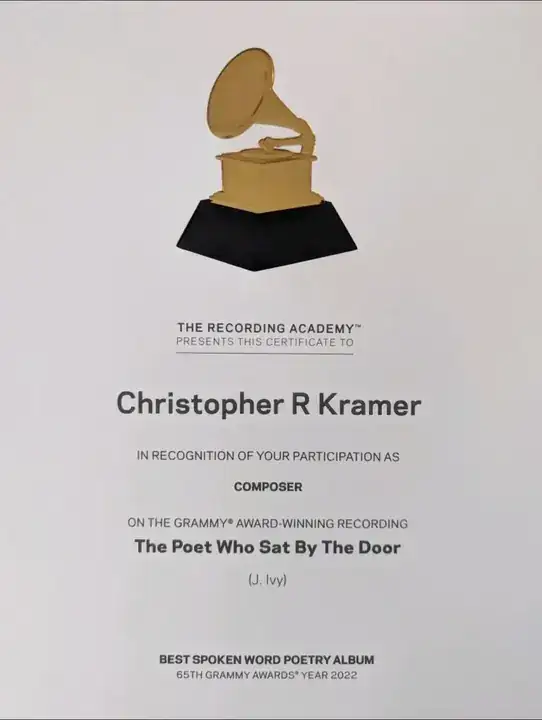
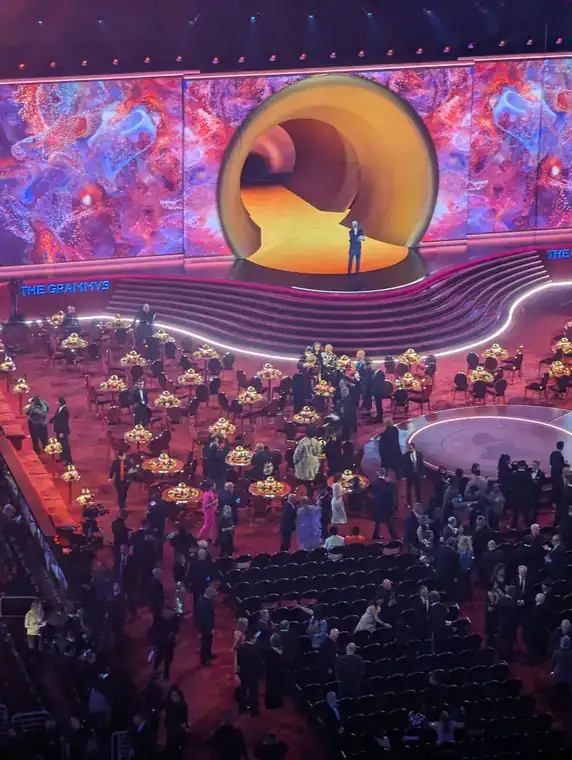
The Recording Academy's certificate carries my legal name, Christopher R Kramer, and the word COMPOSER, for participation on the Grammy-winning recording. It is one of the few documents in my life with my real name on something I actually made.
I want to be accurate about what it meant, because this book has tried to be accurate about everything else. I did not seek it. Nobody promised it. When it came, I sat high up in the arena and watched the stage through my phone's zoom. It was, in my own words, a room I was in rather than a room I was part of. The credit brought me recognition my family had rarely given me, and very little else. Afterward I met some bad guys in the music industry. There are a few bad apples in every orchard, and I will leave it there.
Why this is the pivot
Look at where that certificate sits in the story this book has told.
In 1893, Black musicians were given one day at the fair, before 2,500 people, while 27 million people walked the Midway. Will Marion Cook♪'s opera was canceled. In 1933, Florence Price♪'s symphony was played by an orchestra that would not have let her sit in it. In 1944, J. Ernest Wilkins was separated from his Budapest-born partner by the laws of Tennessee. For more than a century, the meetings in this book produced extraordinary work, and the recognition for that work was partial, delayed, or given to someone else.
In 2023, a Black poet from the South Side of Chicago created a new category at the most visible music award in the world and won it first. On his winning album was a track built from an improvised Chicago jam by a Black finger drummer and a producer whose family had come, generations earlier, from the Ottoman Mediterranean, through a desk in Chicago, and possibly past the Midway. Our names are on the contract, and mine is on the certificate.
It did not fix anything. I still felt the old distance in that arena. But it was the first time in this long story that the meeting itself was named on the highest stage, with the Black artist at the center and the immigrant descendant credited beside him, by his real name, for the thing he actually did.
And it changed me. After the Grammy, with my health restored, I began singing seriously every day, in a full voice I had carried since childhood and never opened. The music I make now as Son Tensei♪ comes out of that.