Picture one block on Chicago's Near West Side around 1920. One family came up from Mississippi on the Illinois Central. Their grandparents had been bought and sold. Another family came from Salonika by way of Marseille. Their grandparents had paid a special tax for their faith, and the old people still told stories about sons taken by the sultan's levy and about neighbours killed in massacres. Neither family knew much about the other. Both carried ancestors who had lived through terrible times, and both had come to Chicago to get out from under them.
This chapter puts those two inheritances side by side. It does it carefully, because comparison can easily turn into competition, and this is not a contest. The point is that the two rivers of this book did not meet by accident. People who had survived ranked, taxed and hunted worlds kept finding each other in this city, and kept making music together.
Plate XI · a
Two rivers, two towers
Mesopotamia means "the land between the rivers." Chicago is a city between two waters, Lake Michigan and the Mississippi, and in 1900 it reversed its own river to join them. Babylon's great ziggurat, the likely model for the Tower of Babel, stood about 91 metres tall. The Sears Tower, the world's tallest building from 1974 to 1998, stands 442. Both cities were built by many peoples speaking many languages. Babylon had its Hanging Gardens, and Chicago's motto is Urbs in Horto, "City in a Garden."
Measured honestly
Start with what is not in doubt. In what became the United States, Africans and their descendants were held in hereditary chattel slavery for 246 years, from 1619 to 1865. By 1860 nearly four million people were enslaved. A Virginia law of 1662 made a child's status follow the mother's, so slavery passed down the generations by law. Abolition did not end it cleanly. Black Codes, convict leasing and Jim Crow followed, along with more than 4,400 racial terror lynchings between 1877 and 1950. Sourced
Ida B. Wells documented those lynchings and carried her campaign to Chicago, where she lived from the 1890s until her death in 1931. Even in Chicago, Black families who came north in the Great Migration were confined to a narrow "Black Belt" on the South Side by restrictive covenants and violence. In July 1919 a Black teenager drifted across an invisible line at a Lake Michigan beach and drowned after being stoned. Seven days of rioting followed: 38 people were killed, 23 of them Black, and 537 were injured. Sourced
The families from the Ottoman lands had survived horrors of their own, including massacres and, in 1915, genocide. Nothing on this page makes those smaller. But in Chicago a difference opened up between the two groups that decided almost everything. As chapter II shows, Syrian immigrants went to court and won the right to be classified as white. A name could be changed at a desk, an accent could fade within a generation, and a grandchild could move to any neighbourhood. The law offered Black Chicagoans no such desk. That is why the Black American experience, taken as a whole, was the worse one: it was longer, it was inherited by law, and it had no exit. Son Tensei's reading
Plate XI · b
Side by side
The two inheritances, measured on the same questions.
| Black Americans | Ottoman minorities and outcasts | |
|---|---|---|
| How long | 246 years of slavery, then about a century of legal segregation | Centuries of second-class status under the millet system, with violence peaking from the 1890s to the 1920s |
| Owned? | Yes. Human beings were legal property, and the status was inherited | Mostly no, but the empire ran a large slave trade. Romani people were enslaved for about 500 years in the Christian-ruled principalities of Wallachia and Moldavia, which paid tribute to the sultan |
| Taxed for who they were | Taxed and denied the vote through poll taxes and literacy tests | The jizya poll tax on non-Muslims. Ottoman registers taxed Roma as a separate category, and Muslim Roma were often charged a poll tax other Muslims did not pay |
| Children taken | Sold away from their parents | The devshirme levy took Christian boys for the Janissaries from the 1300s until the early 1700s |
| Mass killing | Lynching and massacres, such as Elaine in 1919 and Tulsa in 1921 | The Hamidian massacres of 1894–96 and the Armenian, Assyrian and Greek genocides of 1915–23. In the 1940s Salonika's Jews were deported and Europe's Roma and Sinti were murdered in the Porajmos |
| In Chicago | Kept inside the Black Belt; the law held the wall in place | Hostility at first, then, for many, the white box, a new name and a way out |
What they were running from
The Ottoman Empire was enormous, a kind of America before America. At its height around 1683 it covered about 5.2 million square kilometres on three continents and held Turks, Arabs, Greeks, Armenians, Kurds, Assyrians, Jews, Roma, Slavs, Albanians and Africans. It lasted about 600 years. Each faith community ran its own affairs under the millet system, which allowed many peoples to live under one roof. But the faiths were ranked. Christians and Jews were "protected" (dhimmi), which meant tolerated, taxed and never equal. Sourced
Plate XI · c
How big it was
The Ottomans held the land crossroads between Europe, Africa and Asia, and for a time a strong Mediterranean navy: Barbarossa won at Preveza in 1538. But they never built an ocean empire. After the defeat at Lepanto in 1571 they stayed a land power, while the Atlantic powers took the sea routes that later led to America.
The people at the bottom of that order had the most reasons to leave. Roma lived on the margins of every Ottoman city and were taxed and policed as a separate category. North of the Danube, in the tributary principalities of Wallachia and Moldavia, they were held as slaves until 1855–56. After that, many Romani families, among them the Kalderash coppersmiths, spread across Europe and eventually reached the Americas. Sephardic Jews had found refuge in the empire after Spain expelled them in 1492, and Salonika became the largest Sephardic city in the world. When it passed to Greece in 1912, a fire in 1917 left about 70,000 people homeless, most of them Jews, and many left for good. From 1909 non-Muslims could be drafted into the Ottoman army for the first time, and thousands of Christian and Jewish young men emigrated to avoid it. Armenians and Assyrians fled the massacres of the 1890s, then genocide. Mount Lebanon lost as many as 200,000 people to famine during the First World War. Sourced
Many of these families arrived wary of anyone with a form. Being written down by the state had once meant losing a son to the levy, paying the tax, or being on a deportation list. In Chicago they often kept quiet about where they came from, said "Greek" or "French" or "Syrian," and let the desk record whatever it liked. Son Tensei's reading
Plate XI · d
Two ledgers
Above the line, the inheritance of Black Americans. Below it, the inheritance of the Ottoman world's minorities and outcasts. Both lines run toward Chicago.
Chicago, where the two rivers met
Chicago's Black population grew from about 44,000 in 1910 to about 234,000 in 1930, and passed one million by 1970. Through the same decades, Chicago's Greektown grew up on Halsted Street a few blocks from the Jewish market on Maxwell Street, where, as chapter V shows, immigrant merchants ran extension cords to Black blues players. Assyrians built one of the largest Assyrian communities in America on the North Side, and Armenians, Syrians, Lebanese and Roma settled across the city. Early-twentieth-century Chicago sorted people by appearance and language long before it sorted them by papers. Southern Italians, Greeks, Levantines, Sephardim, Roma and Assyrians were seen as more or less the same, and they lived on the same blocks because that was where the rent was cheap and nobody asked questions. Sourced
Plate XI · e
Black Chicago, by census
The Great Migration in one picture.
The same city gave one river a door and the other a wall. That difference is real and should not be blurred. But on bandstands, in record shops, in packinghouses and on Maxwell Street, the two kept meeting anyway, and they understood each other without needing to explain. Son Tensei's reading
The lament as a carrying case
People who fled with almost nothing carried songs. Laments take up no room in a suitcase. The Armenian priest and song collector Komitas gathered village songs before 1915, including the antuni, songs of the homeless wanderer, and "Dle Yaman." He survived the deportations of April 1915 but never recovered, and he died in a Paris hospital in 1935. Sephardic families carried Ladino ballads from medieval Spain through four centuries in the Ottoman lands. Romani musicians made their sorrow into "Gelem, Gelem" ("I went, I went"), which became the Romani anthem in 1971 and remembers the Black Legion of the Porajmos.
The spirituals, the field hollers and the blues did the same work on this side of the water. The bent notes of the blues and the in-between pitches of the maqam are different systems, neighbours rather than twins. Both let a singer press on a note until it holds more than the scale allows. When musicians from the two inheritances met in Chicago, that was often the first thing they recognised in each other. Needs testing
The long way round
Not everyone came straight. Many families from the Middle East and the Ottoman world first went east or south, and learned English under British rule in India and East Africa. Baghdadi Jews moved to Bombay and Calcutta in the 1800s; the Sassoon family later moved on to Britain. Parsi and Gujarati families in East Africa moved to Britain after Kenya's Africanisation policies of the late 1960s and Uganda's expulsion of its Asians in 1972, and some then went on to America. The sociologist Parminder Bhachu called them "twice migrants."
Through England
The same roads ran through British music.
- George Michael was born Georgios Panayiotou to a Greek Cypriot father; Cyprus was Ottoman until Britain took it over in 1878.
- Cat Stevens (Yusuf Islam) also had a Greek Cypriot father.
- Ahmet Ertegun, born in Istanbul to a family of Ottoman and then Turkish diplomats, co-founded Atlantic Records, which released Led Zeppelin and Cream in America.
- Arif Mardin, from Istanbul and met in chapter VII, produced the Bee Gees' "Jive Talkin'."
- Freddie Mercury, born Farrokh Bulsara, was a Parsi from Zanzibar whose family fled to England in 1964.
- Ronnie Wood of the Rolling Stones has spoken about his Romanichal (British Romani) roots.
More about Romani and Parsi
Connections to Zoroaster's way of thinking, and the persecution that followed: two peoples whose roads crossed in Persia, kin in how they saw the sacred, and kept outside by the empires around them.
Read more →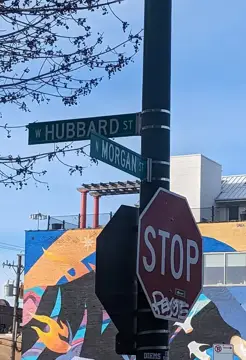
Morgan & Hubbard
One of Chicago's hidden gems: since 1971 the railroad viaduct on Hubbard Street has been an open-air gallery where Black, Latino and immigrant artists paint side by side. One old panel says it in Swahili: upendo ni pamoja, love is togetherness.
See the walls →After 1979: Many Rivers
The story keeps going. From the 1980s the two rivers were joined by Mexican and Puerto Rican Chicago and by outsiders of every kind, in house, hip-hop and the hybrid bands of the 1990s. Read the companion volume, Many Rivers.
Outliers and unsung heroes
Sources and notes
- Equal Justice Initiative, Lynching in America (3rd ed.), 4,400+ racial terror lynchings, 1877–1950.
- US Census Bureau, population of Chicago by race, 1910–1970.
- Chicago Commission on Race Relations, The Negro in Chicago (1922), on the 1919 riot.
- Encyclopedia of Chicago: Greeks, Assyrians, Armenians, Gypsies (Roma), Maxwell Street.
- Elena Marushiakova and Vesselin Popov, Gypsies in the Ottoman Empire (2001).
- Mark Mazower, Salonica, City of Ghosts (2004).
- Ronald Grigor Suny, "They Can Live in the Desert but Nowhere Else": A History of the Armenian Genocide (2015).
- Parminder Bhachu, Twice Migrants (1985).
- Komitas Museum-Institute (Yerevan), biography and song collections.
- The author's archive: Chicago Japan Bay and The Hot Box manuscripts (family history is marked as such).