Chicago · 1893 to now
Two RiversOttoman roots, Black music, and the making of Chicago sound
In 1893 a mile-long fairground ranked the peoples of the world from top to bottom, and put Black Americans and the peoples of the Ottoman world low and near each other. For the next 130 years, many of Chicago's most important musical partnerships formed between exactly those people.
Begin with the prologueContents
Special sections
Black Chicagoans and the families who fled the Ottoman lands both carried ancestors who lived through terrible times. The two inheritances, side by side.
Read chapter 11 →Part 2 · CompanionMore about Romani and ParsiTwo roads that crossed in Persia, and a way of seeing the sacred that both peoples were punished for keeping.
Read more →Part 3 · A hidden gemMorgan & HubbardUnder the tracks on the Near West Side, a row of concrete panels has been an open-air gallery since 1971. Photographs by Son Tensei.
See the walls →Part 3 · 1980 to nowMany RiversAfter 1979 the two rivers widened like the Mississippi into house, hip-hop and hybrid rock. The companion volume.
Read Many Rivers →Part 4 · The beat scenePush BeatsTen producers, a borrowed sound system, a Tuesday night. Chicago's beat scene from 2005 to now, and where it met jazz.
Meet the beat scene →Part 5My storyChicago, Japan, a Grammy, a late-arriving voice and the search for roots, with my range on a piano.
Read my story →In 1893 a mile-long fairground ranked the peoples of the world from top to bottom, and put Black Americans and the peoples of the Ottoman world low and near each other. For the next 130 years, many of Chicago's most important musical partnerships formed between exactly those people.
Contents
Ottoman roots, Black music, and the making of Chicago sound
Part 1 · 1893–1945
Headwaters
From the 1893 Midway to the Second World War: the Great Migration, names changed at immigration desks, and the first records where the two rivers met.
- ✦Prologue→
The Land Between Two Rivers
Mesopotamia means the land between the rivers. Chicago, a city built on redirection, became another meeting place of many peoples, and this book follows one of those meetings.
- 11893→
The Ladder
The 1893 World's Columbian Exposition ranked humanity along the Midway. Black Americans were placed at the bottom and the Ottoman world in the middle, and Colored American Day drew about 2,500 of 27 million visitors.
- 21894 to 1915→
Names at the Desk
Ship manifests had no column for who people were, the census wrote them down as white, and Syrian immigrants won court cases arguing they were white because the alternative was exclusion. Names changed at desks.
- 31916 to 1932→
The Migration Years
The Great Migration remade Chicago. Jazz moved to the South Side, the first racially mixed jazz records were cut, and Black Chicagoans reached toward the Ottoman and North African world for identity.
- 41933 to 1945→
A Century of Progress
The 1933 fair repainted the ladder, and Chicago answered: the Chicago Symphony premiered Florence Price's symphony, the first by a Black woman played by a major American orchestra.
Part 2 · 1945–1979
Confluence
Survivors from the Ottoman lands join Jewish Chicago, Maxwell Street runs extension cords to the blues, and the AACM and Sun Ra rebuild music from the ground up. The two inheritances, side by side.
- 51946 to 1959→
Extension Cords
On Maxwell Street, merchants ran extension cords to blues players, and electric Chicago blues was born. Immigrant families built labels and stores while Black musicians made the music.
- 61960 to 1975→
The Cosmic South Side
A Greek-American bandleader championed Etta James, the AACM was founded, the Pharaohs and Sun Ra claimed Egypt with dignity, and a Greek-American from the Southwest Side wrote "Born in Chicago."
- 11Ancestors→
The Ones Who Fled
Black Chicagoans and families who fled the Ottoman lands both carried ancestors who survived terrible times. The Black American experience was the longer and more total one, but the Ottoman world's outcasts fled a similar kind of place.
- ✧Companion→
More about Romani and Parsi
Romani and Parsi peoples: two roads that crossed in Persia, a way of seeing the sacred close to Zoroaster's, and centuries of persecution by the empires around them.
Part 3 · 1979–2010
The Delta
Cheap machines open the river into a delta: house, hip-hop, industrial and math rock, and the Morgan & Hubbard walls, made by Black, Ottoman, Mexican, Puerto Rican and outsider Chicago.
- 71976 to 1999→
Houses and Crossroads
An Istanbul-born producer made "I'm Every Woman" with Chaka Khan, house music was born at the Warehouse, and the Chicago-built Arkestra recorded in Egypt with Salah Ragab.
- ≈1980 →→
Many Rivers (1980 →)
The companion volume: after 1979 the two rivers widen like the Mississippi into house, hip-hop, industrial, post-rock and math rock, made by Black, Ottoman, Mexican, Puerto Rican and outsider Chicago.
- ◆1971 →→
Morgan & Hubbard
A hidden gem: the open-air mural gallery under the tracks at Hubbard Street, photographed by Son Tensei, with artist credits.
Part 4 · 2010 →
Herma Puma to now
From Herma Puma's Synchromystic in 2010 and Tensei's closet studio to the beat scene, International Anthem, a Grammy and a census box of our own.
- 82000 to 2019→
The Hot Box Years
Amir ElSaffar named his album Two Rivers, Makaya McCraven carried Hungarian folk song and Black jazz in one person, and Tensei built records in a closet studio, premiered by the Los Angeles Times in 2011.
- ♫2005 →→
Push Beats
Ten producers, a borrowed sound system, a Tuesday night. Dance to the Drummer's DB, Push Beats, Open Beats and the nights that kept Chicago's instrumental hip-hop alive, and where it met jazz.
- 92020 to 2023→
The Pivot
A Chicago jam became "A Mile in His Soul," track six on J. Ivy's The Poet Who Sat By The Door, winner of the first Grammy for Best Spoken Word Poetry Album in 2023.
- 102024 and After→
Carrying It On
In 2024 the United States created a Middle Eastern or North African category for the first time. It will appear on the census in 2030. Write it down, credit the players, keep the session files.
Part 5
My story
Son Tensei in short: Chicago, Japan, the Bay, a Grammy, a late-arriving voice and the search for roots that brought it all full circle, with the vocal range on a piano.
Plate I
The ladder
How the 1893 Midway Plaisance was laid out, from the White City outward, as historians describe it.
Plate I · b
The circle
1998, a basement in Carbondale: a cypher, where everyone stands at the same distance from the middle.
Plate II
One day
27 million people visited the 1893 fair. About 2,500 attended Colored American Day. At this scale, one lit square in ten thousand.
Interlude
The other direction
Black lives inside the Ottoman world
The Midway put Black Americans and the peoples of the Ottoman world on neighbouring rungs. The empire itself had Black lives inside it. Afro-Turks are the descendants of East Africans brought into the Ottoman lands through the empire's slave trade, from the Zanj coast, from Sudan, and across the Sahara by way of Libya. Many of their families lived around the Aegean and on Crete.
After the 1923 population exchange between Greece and Turkey, Cretan Afro-Turks were resettled around İzmir. There a spring gathering called Dana Bayramı, the Calf Festival, carried African song and dance inside an Anatolian town. It was held until the 1960s, faded, and has been revived by descendants in recent years.
Ahmet Ali Çelikten, born in İzmir, became one of the first Black military aviators in history, flying for the Ottoman air service during the First World War. Today the Afro-Turkish community is estimated at somewhere between five and twenty thousand people.
So the two rivers in this book were never fully separate. Before either of them reached Chicago, the Ottoman world already had its own Black music, its own festival songs, and its own names written down wrong.
Plate III
What the forms could not hold
Choose a person. See how American paperwork recorded them.
World's Columbian Exposition, Midway concession · Chicago, 1893
- Name
- — not recorded —
- Billed as
- "Oriental" dancer / musician
- Paid as
- concession staff
- The tune
- "snake charmer" melody
The melodies became American standards. The names of the people who played them were never written down.
UNCREDITEDColored American Day programme · Chicago, 25 August 1893
- Name
- Joseph Douglass
- Grandfather
- Frederick Douglass
- Audience
- about 2,500
- Out of
- 27,000,000 visitors
A single day on the programme of a six-month fair that had shut Black Americans out of its planning.
ONE DAYShip manifest · Marseille → New York, 1902
- Race or people
- — no such column before 1903 —
- Place of birth
- — not asked until 1906 —
- Port
- Marseille
- Remembered as
- French? Turkish?
Many steamships collected passengers at several ports. A family from Beirut or Salonika could be remembered by where it boarded.
BY THE PORTNaturalization case · US courts, 1909–1915
- Question
- Is a Syrian "white"?
- If no
- excluded from citizenship
- Argued
- white
- Result
- won
Being classified as Asian could mean exclusion, so Syrian immigrants argued they were white, and won. The ruling hardened into a standard that lasted more than a century.
WHITEName at the desk · Chicago, by family account
- Given name
- Miryam
- Recorded
- Mary
- Surname
- Fortuna
- Recorded
- Fortune
By family account she came out of the Ottoman Mediterranean. Both halves of her name were translated out of her at a desk. The book records this as memory, not documented fact.
TRANSLATEDCensus and birth records · 1979 → 2030
- Recorded as
- White
- Believed
- German
- DNA, 2025
- Mediterranean & Ottoman, Mesopotamian, African, European
- 2030 census
- a MENA box exists
In 2024 the United States created a Middle Eastern or North African category. For the first time, the form can hold a little more of the story.
CONVERGENCEInterlude
Through Europe
The postwar road into America
The 1924 Immigration Act's national-origins formula all but closed the door on the eastern Mediterranean. When it reopened after the Second World War, the road ran through Europe.
The Displaced Persons Act, signed on 25 June 1948 and widened on 16 June 1950, admitted 393,542 people by 30 June 1952. The first ship under the Act, the USAT General Black, left Bremerhaven and reached New York on 30 October 1948 with 813 displaced persons aboard. Families whose roots lay in Ottoman lands, Armenians, Greeks, Assyrians, and Balkan and Levantine peoples, often arrived this way, recorded by the last European country that had held them rather than by where their grandparents were born. Many of the mixed families in this story, with deep roots in the Middle East and North Africa, reached America by exactly this kind of European transit.
Hart–Celler, signed on 3 October 1965, ended the national-origins quotas altogether on 1 July 1968. Egypt's annual quota had been 100; by 1970, 4,734 Egyptians arrived in a single year. In Chicago the Assyrian community, whose first church opened in 1917, grew along Devon Avenue, where the Assyrian American Association stands at 1618 West Devon. The 2000 census counted 15,683 Assyrians in the city. Earlier waves belong to the same story: 54,057 Armenians arrived between 1899 and 1917, and about 85 percent of the first Arabic-speaking immigrants came from Mount Lebanon.
In 2020 about 3.5 million Americans reported Middle Eastern or North African ancestry, with no box of their own to check. In 2024 the federal standards changed, and the 2030 census will include one. Families recorded as white for a century will be able to write down a little more of where they came from.
Plate IV
Roads to Chicago
Three waves from the Ottoman lands and the Balkans, and the laws that opened and closed them.
Chapter 8 · The Hot Box Years
Chicago, on the record
Professional since 2010: Herma Puma on First Word Records (UK), then Tensei, premiered by the Los Angeles Times in 2011.
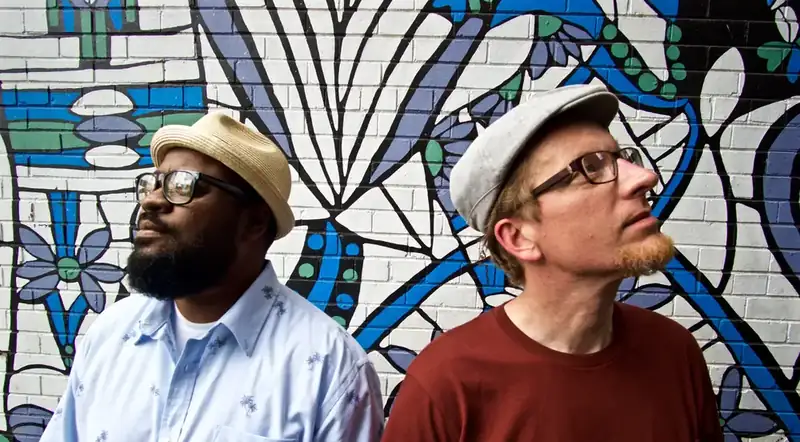

Tensei♪, the Chicago duo of Midas Wells♪ and Christopher R. Kramer, made records in a closet studio in Humboldt Park, with Makaya McCraven♪, Junius Paul♪, Greg Spero♪, Brandee Younger♪, Angel Bat Dawid♪, Georgia Anne Muldrow♪, Black Thought♪, ADaD♪ and A. Billi Free♪ on the sessions. Read their story in the music room, or keep listening here.
✦ · ♪ · ◐ · ▶
Four rooms, one story
Sources and notes
- This book draws on published histories, archives, and reference works, and on the author's own records and memory. Family history is identified as such in the text.
The fairs
- Library of Congress, Songs of America: "The 1893 World Columbian Exposition in Chicago."
- Inter Ocean, August 26, 1893, report on Colored American Day, via Chicagology.
- Christopher Robert Reed, work on Colored American Day and the Black presence at the 1893 fair.
- Smarthistory and other scholarly summaries of the Midway Plaisance's ethnographic layout, drawing on Robert Rydell.
- Cheryl R. Ganz, The 1933 Chicago World's Fair: A Century of Progress (University of Illinois Press, 2008).
- Encyclopedia of Chicago, "Century of Progress Exposition."
- Chicago Symphony Orchestra Rosenthal Archives on the 1933 premiere of Florence Price's Symphony in E minor.
Music and people
- City of Chicago and Maxwell Street Foundation histories of the Maxwell Street Market.
- Histories of the "Arabian riff" and "The Streets of Cairo," including research on its French and Algerian antecedents.
- Richard C. Jankowsky and others on North African trance traditions; Susan Nance and others on the Moorish Science Temple and the Ahmadiyya in 1920s Chicago.
- Paul Street and Rick Halpern on the Packinghouse Workers Organizing Committee.
- Biographical sources on Karl Malden, Laszlo Moholy-Nagy, J. Ernest Wilkins Jr., Eugene Wigner, Abe Saperstein, Anton Cermak, the Chess family, Johnny Otis, Arif Mardin, Salah Ragab, Amir ElSaffar, and Makaya McCraven.
- University of Chicago Library, Alton Abraham Collection of Sun Ra.
- Chicago Sun-Times (obituary, October 2024) and Chicago Reader on Nick Gravenites; histories of the Paul Butterfield Blues Band and Mike Bloomfield.
- AllMusic (Thom Jurek) and other biographies of Greg Spero; press and label materials on Nico Segal and the Social Experiment.
- Mezz Mezzrow and Bernard Wolfe, Really the Blues (1946).
- Chicago Reader coverage of the Hamid Drake and Michael Zerang winter solstice concerts; Links Hall and artist materials.
- Histories of the Hot Mix 5 and WBMX, including Mixmag and Time Out Chicago.
- Histories of Aristocrat Records; NPR, JazzTimes, and Chicago Reader obituaries of Bob Koester; NEA and Chicago Sun-Times on Joe Segal.
- Georgetown University Library and other sources on Margaret and Estella Bonds.
- Rotary Connection discography and album histories, including AllMusic reviews by Andy Kellman and Nigel Williamson's Rough Guide to the Best Music You've Never Heard.
- International Anthem Recording Company label materials, and coverage in Clash, South Side Weekly, and Treble.
- Published biography of Mathien (Chris Mathien).
- The author's discography records and press files for Plug Research, First Word, Bastard Jazz, and Tokyo Dawn releases.
- Label and press materials for Tensei releases on Plug Research and Tokyo Dawn Records.
- Recording Academy (Grammy.com) and NPR on the 65th Grammy Awards and the Best Spoken Word Poetry Album category.
Notes on accuracy
- Each era's song list includes only records by people named in that chapter, in chronological order. Records that were never popular hits are marked (underground/indie). The lists are not chart rankings.
- The claim that Tensei was the first of Chicago's 2010s jazz-inflected beat acts to land in major press is the author's own; the dates of the Los Angeles Times premiere (2011), International Anthem's launch (2014), and In the Moment (2015) are documented.
- Sol Bloom's claim to have composed the snake-charmer melody is disputed; the melody has earlier French and Algerian antecedents.
- The link between the Midway "hoochie coochie" and Willie Dixon's "Hoochie Coochie Man" is unproven; Dixon's lyric refers to hoodoo.
- Scott Joplin's presence at the 1893 fair is a popular legend that is not documented in the Colored American Day program.
- Accounts differ on how the Harlem Globetrotters were founded; Dick Hudson and Abe Saperstein are both credited.
- The author's great-great-grandmother's presence at the 1893 fair rests on family account and has not yet been documented.
- Mathien's published biography relies heavily on self-reported sources; details should be confirmed with the artist.
- "Ottoman" is used in this book for anyone with roots inside the empire's historic boundary, of any faith and any period.
- Wikipedia: Afro-Turks
- Wikipedia: Ahmet Ali Çelikten
- Wikipedia: Immigration Act of 1924
- Wikipedia: Displaced Persons Act
- Wikipedia: Immigration and Nationality Act of 1965
- Wikipedia: Middle Eastern and North African Americans
- Wikipedia: Assyrians in Chicago
- Wikipedia: Armenian Americans
- Wikipedia: Arab Americans